
Use the Summer Slowdown to Get Interview-Ready (2026)
Most people treat interview prep like a fire drill. The recruiter emails. The interview lands on Thursday. They open a tab Wednesday night and start memorizing.
That is the wrong order of operations, and it shows. The fall hiring ramp hits hard in September and October. The candidates who win it started in July, while everyone else was on the beach.
The summer lull feels like dead time. It is the opposite. It is the only stretch of the year where you can practice without an interview riding on the outcome. Use it.
Key Takeaways
- Night-before cramming produces rehearsed lines that crack under real questions.
- The summer slowdown is the only low-stakes window to practice before the fall ramp.
- Interviewers test the thinking behind your answer, not the answer itself.
- The strongest answers come from your actual experience, not borrowed scripts.
- A light weekly cadence beats one panicked all-nighter every time.
Why night-before prep fails
Cramming gives you lines. It does not give you readiness.
You memorize a "tell me about yourself" paragraph. You rehearse a tidy story about a project that went well. Then the interviewer asks a follow-up you did not script, and the whole thing falls apart. You stall. You fall back to filler. The polish you practiced makes the gap more obvious, not less.
Rehearsed lines are brittle because real interviews are conversations, not recitals. A good interviewer pulls a thread. They ask why you made that call, what you would do differently, who pushed back. A script has no answer to a question it did not anticipate.
The cure is not more lines. It is fluency with your own material. And fluency takes reps you cannot fake at 11 p.m. the night before.
The summer prep advantage
Here is what makes summer different. There is no interview on the line.
When you practice in August with nothing scheduled, a bad rep costs you nothing. You can fumble an answer, hear how it sounds, and fix it. You can try three different ways to tell the same story and keep the one that lands. That freedom disappears the moment a real interview is on the calendar and every rep feels like a dress rehearsal for a test you might fail.
Harvard's career office frames interview readiness as a practice, not a cram session — something you build through repetition and reflection over time, not the night before (career.fas.harvard.edu). The slow weeks are exactly when that repetition is cheap.
You also have time to be honest with yourself. In a panic, you accept your first draft. With weeks to spare, you can notice that your best story is actually boring, that you lean on the same example for everything, that you have never once said your salary number out loud without flinching. Those are fixable problems — but only if you find them early.
Learn to decode what interviewers are actually testing
Most candidates answer the question on the surface. The strong ones answer the question underneath it.
"Tell me about a time you disagreed with your manager" is not a request for a story. It is a test. The interviewer wants to know whether you can hold a position without being difficult, whether you escalate or stew, whether you can disagree and still ship. The story is just the vehicle.
Once you start reading questions this way — asking what is this really testing — your prep changes. You stop collecting anecdotes and start choosing the ones that prove the trait behind the question. You answer what they meant, not what they literally said.
That decoding skill is the whole game in behavioral rounds, and it takes practice to build. We go deep on it in behavioral interview questions, decoded. For now, the move is simple: before you answer anything, ask what the question is really measuring.
Build answers from your real experience, not borrowed scripts
There is a tempting shortcut. Search "best answer to weakness question," copy the script, memorize it.
It does not work, and interviewers can smell it. Borrowed answers sound borrowed. They are generic where they should be specific, and they collapse the instant someone asks a real follow-up about a project you never actually did.
Your real experience is the only material that survives scrutiny. The time the launch slipped and you had to tell the client. The decision you made with bad data that turned out right. The conflict you handled badly and learned from. These are not polished, but they are yours — which means you can answer any follow-up because you lived it.
The work of summer prep is mining that material. Go through your last two or three roles. For each meaningful project, write down what you owned, what went wrong, what you decided, and what changed because of you. That raw inventory is your answer bank. Research on hiring consistently finds that structured, evidence-based interviews predict performance better than gut-feel chats (hbr.org) — which means the candidate with concrete, specific examples has a real edge over the one reciting platitudes.
A practice cadence for the slow weeks
You do not need a bootcamp. You need a light, repeatable routine across the slow stretch. Three moves, run weekly:
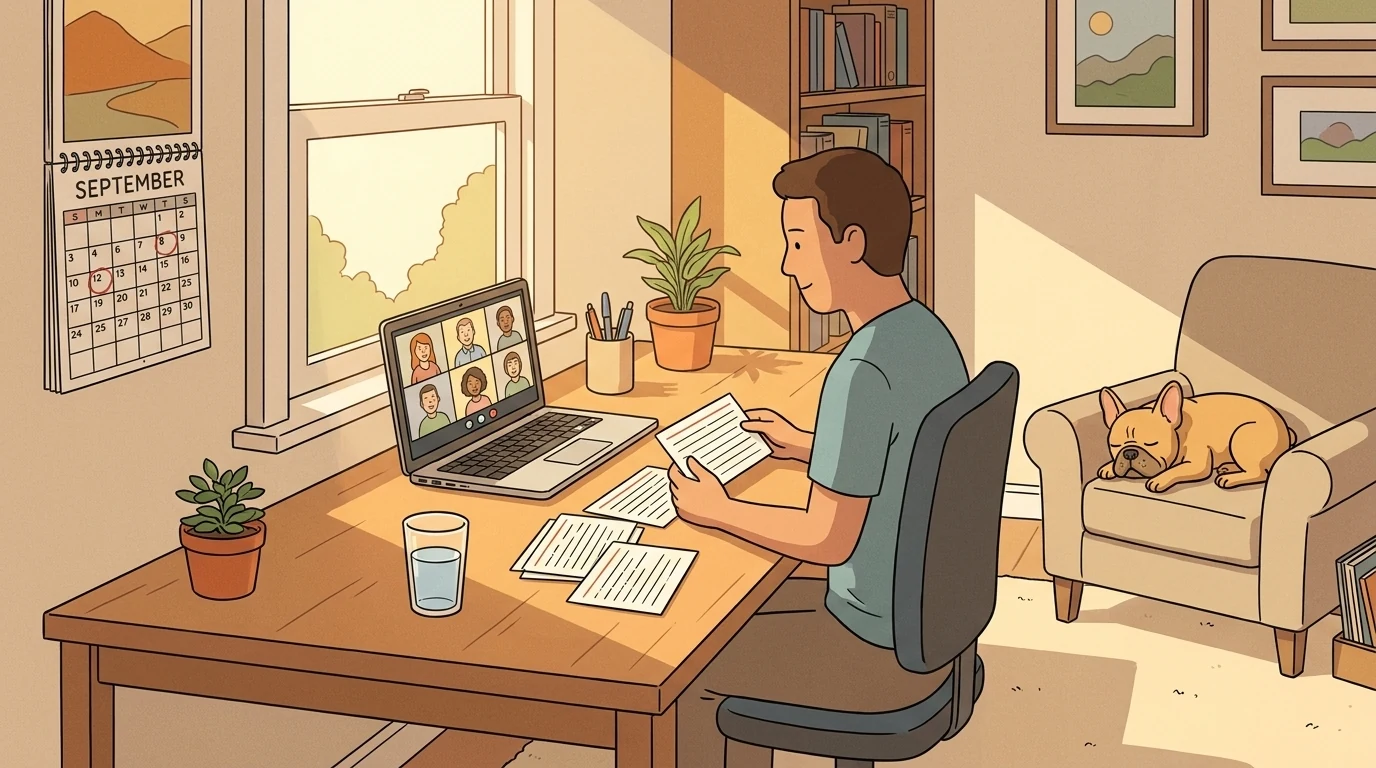
Record yourself. Answer a question out loud, on camera, then watch it back. It is uncomfortable. It is also the fastest feedback loop you will ever get. You will catch the filler words, the rambling, the place where you lose the thread — things you cannot hear in your head.
Research target companies. Pick the places you actually want to work this fall and study them now. What they ship, who they serve, how they talk about themselves. When the interview comes, your interest will be real and specific instead of flattering and vague.
Run reps out loud. Reading your answers is not practicing. Saying them is. Talk through your stories on a walk, in the car, to a friend who will ask follow-ups. Out-loud reps are what build the fluency that scripts cannot.
When fall gets close and you want to compress all of this into a final sprint, we have a tight plan for that too: prepare for an interview in one week. But the candidates who run reps all summer barely need it.
Arrive at fall calm while everyone else crams
Picture September. The postings come back. The recruiters start moving. Everyone in your feed is panic-prepping.
You are not. You spent the summer building fluency with your own stories, decoding what questions actually test, and running enough reps that walking in calm is just muscle memory. The interview is not an exam you have to pass cold. It is a conversation you have already had with yourself a dozen times.
That calm is the whole point. It is also hard to build alone, which is the gap Gate Crashers closes. Pay once, around $4.99 — no subscription, no card on file — and you get three tailored resume versions plus an interview script built from your own experience, so you walk in with answers ready in your own words. Bundle the interview script with the resume rewrite and turn this summer's reps into a fall offer.
Start now. Your future self, walking into that October interview unhurried, will thank you.