
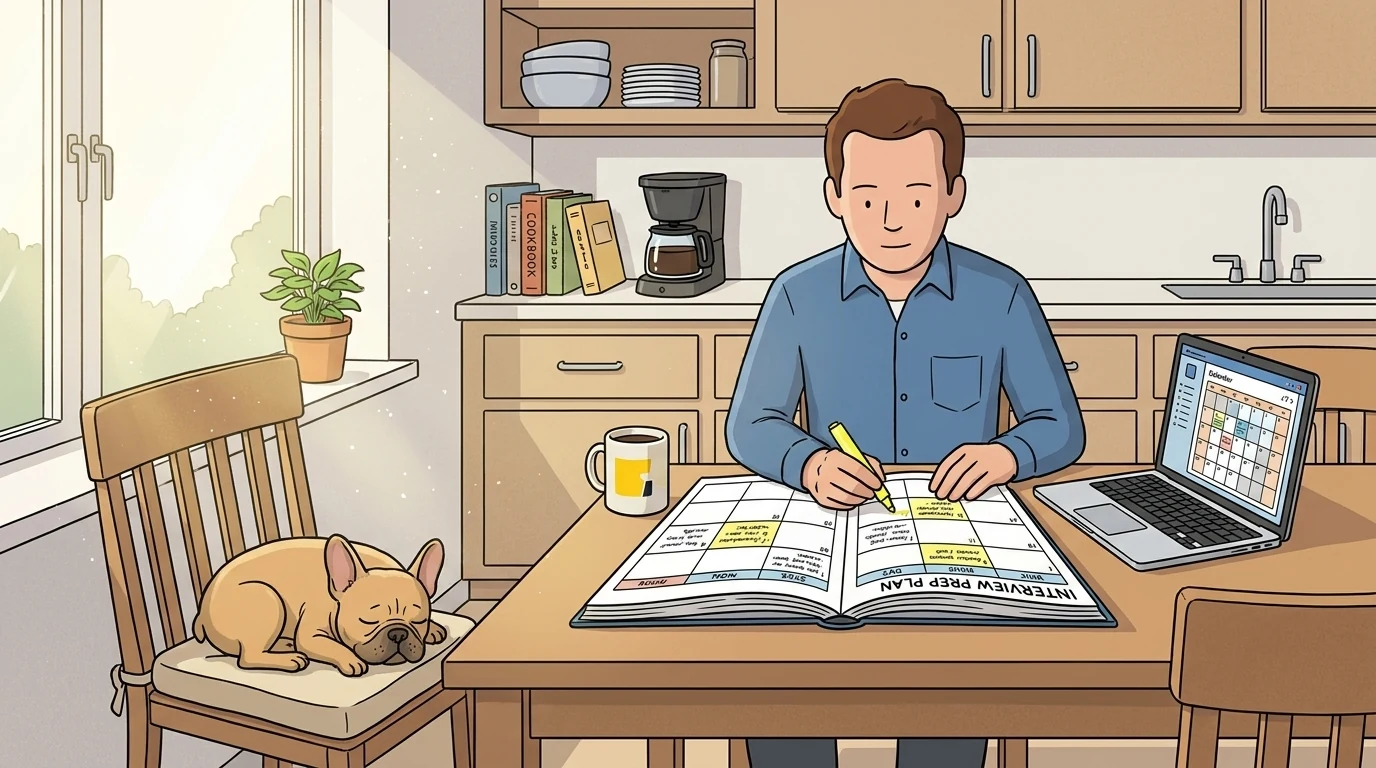
How to Prepare for an Interview in One Week
You booked the interview. It's five to seven days out. And the panic voice in your head says that's not enough time.
It is. The problem isn't the clock. The problem is that most people spend the week doing the wrong things — rereading the job post forty times, memorizing canned answers, cramming company trivia they'll never use. That's motion, not preparation.
A week is enough when you spend it deliberately. One job, a few hours a day, a plan that builds instead of loops. Here's how to run it.
Key Takeaways
- A week is plenty of prep time if you work a plan instead of spinning in place.
- Spend Days 1–2 on research, Days 3–4 drafting answers from your own experience, Days 5–6 rehearsing out loud, Day 7 on logistics and rest.
- Build answers from things you actually did — borrowed scripts fall apart under follow-up questions.
- Learn what each question is testing, not just what it asks.
- Skip word-for-word memorization and last-minute trivia cramming.
A week is enough if you're systematic
Most interview anxiety comes from doing prep that feels productive but isn't. You can read a company's "About" page a dozen times and learn nothing new on the eleventh.
Real preparation has three jobs: know who you're talking to, know what you bring, and be able to say it under pressure. Each one takes a couple of focused days. Stack them in order and the week handles itself.
So block your days now. Two for research, two for drafting, two for rehearsal, one for logistics. Treat it like a project with a deadline, because it is.
The day-by-day plan
Days 1–2 — Research the company, the role, and the questions.
Start with the job description, but read it like a list of demands, not a brochure. Every responsibility line is a hint about what they'll ask. "Manage cross-functional projects" means a behavioral question about coordinating people is coming.
Then learn the company past the homepage. Recent news, the product, who their customers are, what's clearly changing for them right now. Harvard's career office recommends researching the organization and the role together so you can connect your background to what they actually need — see career.fas.harvard.edu for how thorough that should be.
By the end of Day 2, you should have a written list of ten to fifteen questions you'll likely face, pulled straight from this job.
Days 3–4 — Draft answers from your real experience.
This is where the week is won or lost. For each likely question, write a short answer built on something you genuinely did. A real project. A real conflict. A real number you can defend.
Do not borrow scripts off the internet. Generic answers sound generic, and they collapse the moment an interviewer asks "what would you have done differently?" Your own stories don't, because you were there.
The other half of these two days is learning to decode what each question is really testing. "Tell me about a time you failed" isn't fishing for a failure — it's checking whether you can own a mistake and show what changed after. "Why do you want this role?" is testing whether you understand the job at all. Once you can hear the question behind the question, you stop answering literally and start answering well. (That decoding is its own discipline, and it's exactly what we build into a script for you — more on that below.)
If you've got more runway than a week, the same approach scales: here's how to get interview-ready over the summer so a fall interview never feels rushed.
Days 5–6 — Rehearse out loud and build your questions for them.
Reading your answers silently is not rehearsal. Say them out loud. Record yourself on your phone, play it back, and notice where you ramble or stall. It's uncomfortable. It's also the single fastest way to improve.
Run a mock interview against your own question list. Cut every answer that runs past ninety seconds. Tighten the openings. Then prepare the questions you'll ask them — sharp ones signal that you've thought about the role, and they flip the dynamic from interrogation to conversation. Steal a few from our guide to questions to ask the interviewer.
Day 7 — Logistics and rest.
Confirm the time, the format, the link or the address. Lay out what you're wearing. Test your camera and mic if it's remote. Skim your answer notes once, then close the laptop.
Don't add new prep on Day 7. You're not learning anything new this late — you're just making sure nothing trips you up tomorrow.
The night before
Stop studying. Read your story notes one last time, light and quick, the way you'd glance at a map before a drive — not memorize it turn by turn.
Then sleep. A rested brain recalls your own experiences far better than a tired one that crammed until midnight. HBR's research on interview performance points to composure and clear thinking over rehearsed perfection, and you can read more on that at hbr.org. Set your alarm early enough that the morning isn't a scramble.
What to skip
Two traps eat people's week.
The first is memorizing answers word-for-word. Recited answers sound recited, and one unexpected follow-up derails the whole thing. Know your stories, not your sentences.
The second is cramming trivia. You don't need the CEO's college major or the company's 2014 funding round. Interviewers test judgment and fit, not your ability to recall facts you could've Googled. Skip the trivia, keep the substance.
That's the week. Research, draft, rehearse, rest — in that order, no looping.
If you want the draft-and-decode part done with you instead of alone at your kitchen table, that's what we do. Gate Crashers builds an interview script from your own experience — your real projects, framed against what each question is actually testing — so a week is more than enough. Start your script for about $4.99, one time. No subscription, no card on file.