
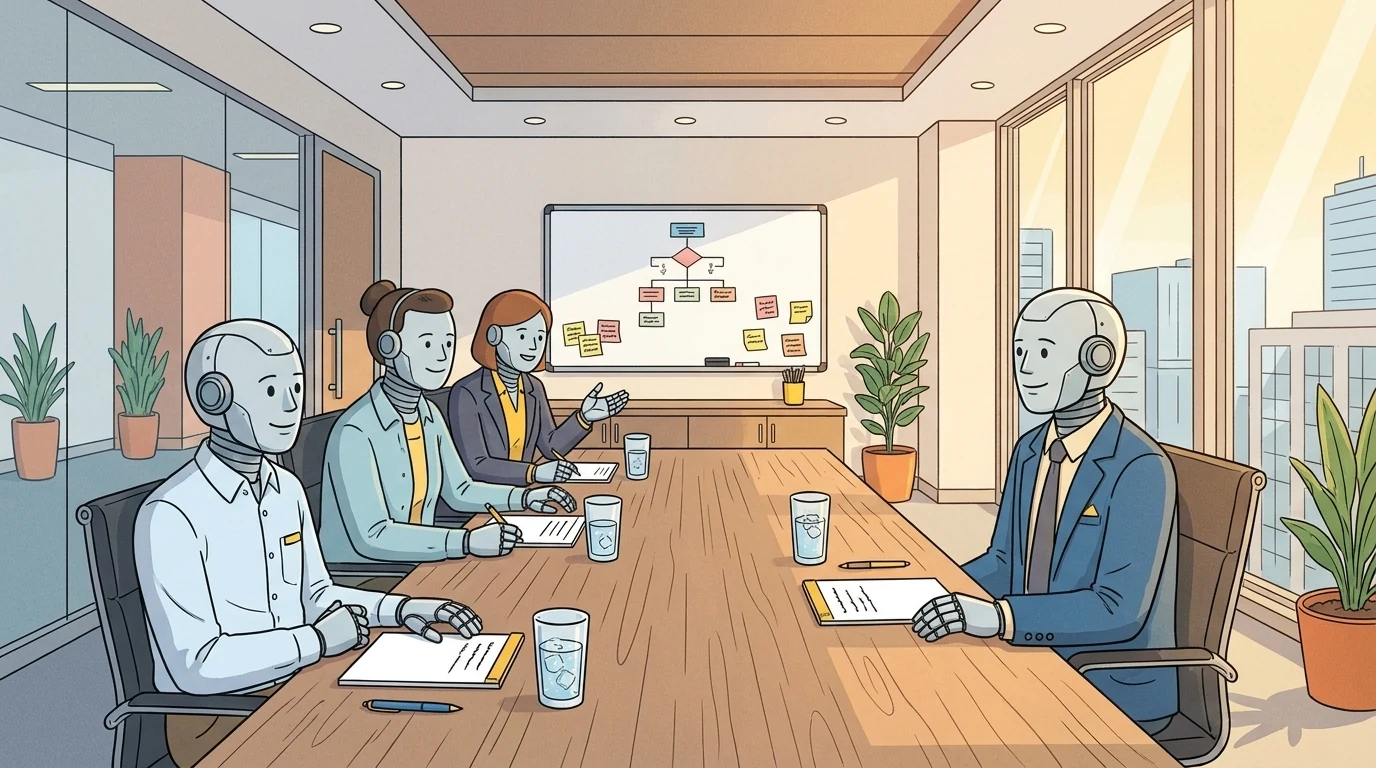
Final Round & Panel Interviews: What's Different
You made it to the last round. Most people treat it like another screen — same answers, same energy, one more box to check.
That's the mistake. The final round is a different game with different judges, and the people in that room are deciding, not screening. Walk in with the same playbook and you'll feel the floor shift under you.
Here's what changes, and how to handle a room instead of a person.
Key Takeaways
- The final round is the decision stage — the people in the room are choosing, not filtering.
- A panel evaluates fit and consistency: can they picture you on the team next quarter.
- Address the person who asked, but bring the whole panel into your answer.
- Your story can't drift between interviewers — they compare notes afterward.
- Close with a sharp "why this team, why now," and a real question for each person.
Why the final round is a different game
Earlier rounds filter. The final round decides.
By now you've cleared the recruiter screen and probably a hiring-manager call. Those rounds existed to rule you out. The final round flips it. The people in the room are weighing whether to spend an offer, a seat, and six months of onboarding on you specifically. That changes the stakes, and who's watching.
It's often a panel. You might face your future manager, a peer you'd work next to every day, and an exec two levels up who signs off on the hire. Each one scores something different. The peer wants to know if you'd be a pain to work with. The exec wants to know if you'd embarrass them. The manager wants to know if you'd make their life easier or harder.
You're not answering questions anymore. You're auditioning for a chair at a table these people already sit at.
What a panel is really evaluating
The questions sound like the earlier rounds. What they're testing is not.
A panel is mostly measuring three things, and none of them show up on the agenda. First, fit — can these specific people picture working with you, not just hiring you. Second, consistency — does the story you told the recruiter match the one you're telling now. Third, the can-they-see-you-here test: when they imagine the team in three months, are you in the picture.
That last one is quieter and more powerful than candidates realize. People hire the person they can already visualize on the team. Research on hiring keeps landing on the same point: structured, evidence-based evaluation predicts performance far better than gut-feel impressions (hbr.org) — but panels are still made of humans, and humans hire who they can see. Make that picture easy to draw.
The move that matters at this stage is reading the room: before you answer, clock who's in front of you and what each one is quietly testing.
How to handle a room
A panel feels like a firing squad until you learn to run it like a conversation.
Get names. When you sit down, catch each person's name and what they do, and use them. "To your point, Maria—" lands differently than an answer aimed at the table. If you missed a name, ask. It reads as composure, not weakness.
Address the asker, include the panel. Start with the person who asked — eye contact, a beat of direct connection. Then widen out. Let your eyes move to the others as you answer so nobody feels like furniture. You're talking to one person and the whole room at once.
Manage the cross-talk. Panels interrupt each other. Two people will ask half a question at the same time. Don't pick a favorite. "Let me take David's first, then come back to yours" keeps you in control and shows you can run a meeting, which is half of most jobs.
Handle the repeat question. Someone will ask what another person already asked. Don't sigh. Don't say "like I mentioned." Answer it fresh, maybe add a new detail. They're often testing whether your answer holds up the second time.
Stay consistent — they compare notes
Here's the trap nobody warns you about. After you leave, the panel huddles.
They debrief. They compare what you told each of them. And the fastest way to lose an offer at this stage is a story that drifted. You told the manager the project slipped because of scope creep. You told the exec it slipped because of a vendor. Now both wonder which version is true — and whether either is.
Consistency isn't about memorizing a script. It's about knowing your real experience cold enough that the same story comes out the same way every time, no matter who asks. That's why the candidates who did the reps over the slow weeks walk in steady — if you've got runway, get interview-ready over the summer so your material is automatic by the final round. When the story is true and you know it down to the details, it can't drift. You're not reciting. You're remembering.
The close that wins
The last ten minutes carry more weight than you think. Most candidates coast. Don't.
Land a sharp "why this team, why now." Not why the company — why this team, these people, this moment. Tie it to something specific you learned in the room: a problem the manager mentioned, a direction the exec hinted at. Harvard's career office frames the strongest closes as specific and forward-looking, not flattering (career.fas.harvard.edu) — show them the version of you that's already working there.
Then bring a real question for each interviewer — one tailored to what each person owns. Ask the peer what the team gets wrong. Ask the exec where the business is headed. A pointed question for the senior person in the room signals you can think at their altitude. For a bank of these, questions to ask the interviewer breaks down which land and which fall flat.
The follow-up
Send a thank-you that proves you were present. "Thanks for your time" is noise. Reference something specific — the architecture problem the engineer raised, the offhand comment about Q3 — so the note reads like it could only have been written by someone in that room. One sharp detail beats three paragraphs of gratitude.
The mistakes that cost the offer
Treating it like the phone screen. Same answers, lower energy, no read of the room. The stakes went up; act like it.
Fixating on one interviewer. You like the manager, so you talk only to them. The peer and the exec feel ignored — and they both get a vote.
Inconsistent answers. The story that shifts between rounds. They will catch it in the debrief.
No questions for the senior people. You grilled the peer and went blank when the exec asked what you wanted to know. That silence reads as "I don't belong at this level."
Most of these come down to one thing: a story that doesn't hold up under multiple sets of eyes. Gate Crashers gives you an interview script built from your real experience — pay once, around $4.99, no subscription — so your answers stay consistent across every interviewer in the room. Build your interview script with the resume rewrite and walk into the final round telling one true story, every time.