
ATS Keyword Matching: Why "Led a Team" Fails but "Project Management" Passes
Modern Applicant Tracking Systems score resumes by matching the exact phrases and close variants that appear in the job description. They are better at synonyms than they were five years ago, but they still miss most of the casual, human ways you describe your own work. "Led a team" and "project management" describe the same job. One clears the filter because the posting asked for it word-for-word. The other disappears because the parser never learned the connection.
The fix is not to stuff keywords. The fix is to mirror the posting's language inside sentences that still sound like you.
Key Takeaways
- ATS parsers score exact-phrase and close-variant matches against the job description, casual synonyms often do not register.
- "Mirror, do not paste": rewrite your real experience using the posting's specific terminology, not a separate keyword list.
- Two places matter most for matching: the skills section and the first line of each role bullet.
- Over-stuffing triggers both the system (relevance penalty) and the recruiter (reads as robotic). The ceiling is about 3 exact-phrase repeats per term.
How ATS matching actually works in 2026
Most ATS platforms run two scans. First, a parse: the software pulls your content into structured fields (name, company, title, dates, skills). Second, a match: it compares the parsed text against the posting's stored requirements and assigns a relevance score.
The matcher looks for three things in descending weight: exact phrase matches, close variants with the same stem (manage / managed / management), and semantic clusters the vendor has trained on. That third bucket is where 2026 systems are genuinely smarter than 2020 systems, they know "team lead" is close to "people manager", but the improvement is uneven. Niche industry phrasing ("cross-functional collaboration," "stakeholder alignment," "P&L ownership") is still matched mostly by exact string, because there is not enough training data for reliable paraphrase detection.
The working assumption: treat the posting's specific phrases as required. Treat your personal way of describing the same work as optional.
The comparison: "managed a team" versus "project management"
Take a standard PM posting. The requirements section reads:
Experience with project management, cross-functional collaboration, stakeholder alignment, and delivery of multi-quarter roadmaps.
A candidate who led three product launches writes: "Managed a team of 6 to ship three product launches on schedule."
The sentence is clean, specific, and human. It is also a near miss for the parser. "Managed a team" will match the verb stem manage but not the noun phrase project management. "Ship" does not register as delivery. "On schedule" is not roadmap.
Rewritten to mirror the posting: "Owned project management for three product launches, aligning 6 cross-functional stakeholders to ship each on a 2-quarter roadmap."
Same work. Same truth. Four exact-phrase hits: project management, cross-functional, stakeholders, roadmap. The parser scores it higher and a human still reads it as a real sentence. That is the whole move.
Where to put the matches
Two zones carry almost all of the matching weight. Fix these first.
1. The skills section. This is the highest-use real estate on an ATS resume. List the posting's hard-skill terms exactly as written, tool names, methodologies, acronyms (SQL, Figma, Agile, OKRs). Do not paraphrase here. If the posting says "Google Analytics 4," do not write "web analytics." If it says "A/B testing," do not write "experimentation."
2. The first line of each role bullet. ATS parsers weight the opening phrase of each bullet more heavily than what follows. Front-load the posting's verb and noun pair, then explain what you did. "Led cross-functional collaboration across engineering, design, and research to …" gets parsed as a direct match before the reader even reaches the result.
Every other zone, summary, education, certifications, matters less. Do not contort those sections to force matches.
Where keyword stuffing starts hurting you
The ceiling is roughly three exact-phrase repeats per high-value term across the whole resume. Past that, two things happen.
The parser applies a relevance penalty. Modern systems measure term density against document length; hit the same phrase eight times in a one-page resume and the match score drops rather than climbs. Vendors rolled this out specifically to defeat the 2018-era trick of pasting the full job description in white text at the bottom of the file.
The recruiter notices. A resume where every bullet starts with "Project managed cross-functional stakeholder alignment" reads as machine output. It clears the first gate and fails the second, which is the only gate that decides whether you get a call.
The practical rhythm: three exact matches per priority term, distributed across skills and bullets. Synonyms carry the rest of the sentence.
The 10-minute keyword pass
A disciplined pass on a tailored resume looks like this.
- Pull the top 8 nouns and noun phrases from the posting's requirements and responsibilities sections. Ignore the fluff in "about us."
- Drop the hard-skill items into your skills line exactly as written.
- For each role bullet, rewrite the first phrase to mirror one posting term, keeping the rest of the sentence honest to what you did.
- Read the full resume top to bottom. If any sentence reads like it was written by a search engine, rework it until it sounds like you again.
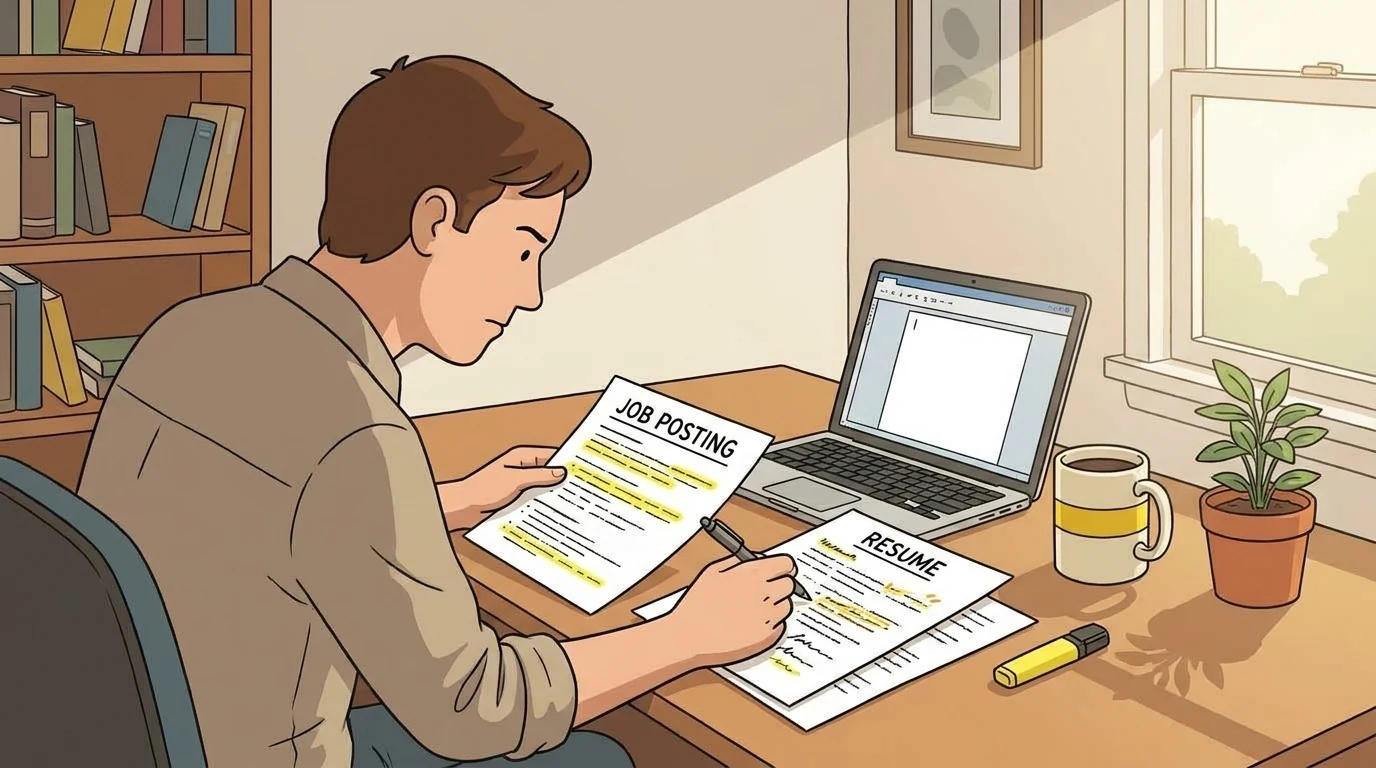
Ten minutes. No templates, no highlighter plugins, no word count anxiety.
FAQ
Does ATS read synonyms now? Better than before, but unreliably on industry-specific phrasing. Exact-phrase matches on the posting's own language are still the safest bet.
Should I put keywords in white text at the bottom? No. Modern parsers strip font color before matching, and several systems flag the document for manipulation when they detect it.
How many keywords is too many? Roughly 3 exact-phrase repeats per priority term. Past that, you are losing parser score and recruiter trust at the same time.
Do I need to tailor every application? Tailor to the posting family, not every single listing. Most roles in the same title share 70% of their keyword set. Rework the shared 70% once, mirror the unique 30% per application.
The point of mirroring is not to game the system. It is to translate real work into the specific language the system was trained on, so a human actually reads it.
Pay once, no subscription. $4.99. Gate Crashers generates a tailored resume and a 12-question interview script from the details you provide, both mirrored to the exact posting, all files yours.