
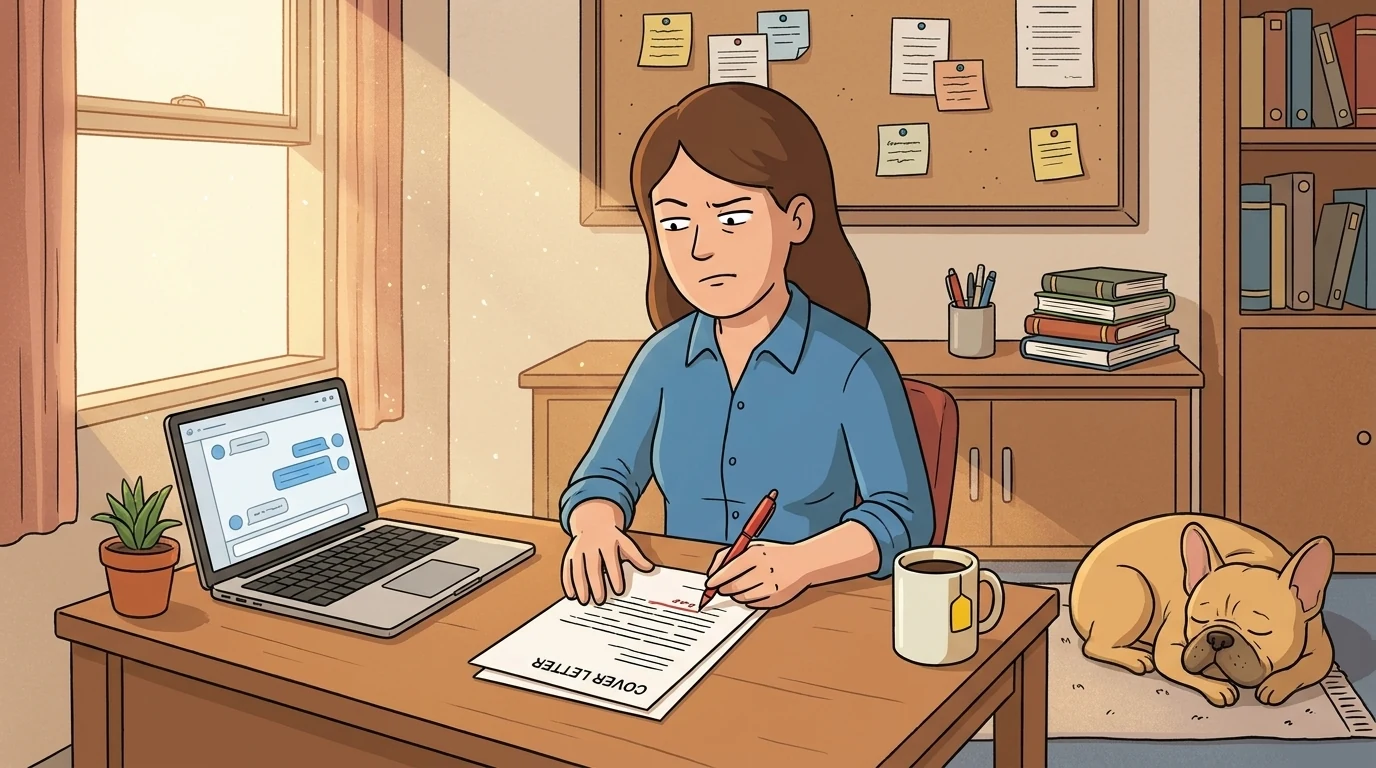
AI Cover Letters: When They Help and When They Flop
You've got the job post open in one tab and ChatGPT in another. The plan is simple: paste the description, hit enter, copy the output, send. We'd push back on the copy-and-send part, not the AI part. We build with AI every day. The problem isn't that you used a machine. The problem is that the machine writes the same letter for everyone, and a recruiter who reads cover letters for a living can feel that from the first sentence.
So here's the honest split: AI is excellent at the parts of a cover letter that don't matter much, and weak at the one part that does. Use it for the first, do the second yourself.
Key Takeaways
- AI is best as a starting point — it beats the blank page and gives you structure fast.
- Raw AI output reads as generic because it has no real detail about you or the company.
- Recruiters who read dozens of these a week clock the pattern quickly.
- The fix: AI drafts the skeleton, you write the one company-specific line and the real story.
- Always cut the throat-clearing opener, the empty enthusiasm, and any "fact" you can't back up.
When an AI cover letter helps
The blank page is the real enemy, and AI kills it. Paste in a job description and you get a full draft in seconds — something to react to instead of a blinking cursor. That's worth a lot. Most people stall not because they can't write, but because they can't start.
It's also good at structure. A solid cover letter has a shape: a hook, a middle that connects your experience to their need, a close. AI nails that shape every time. If you've never written one and don't know the cover letter template that doesn't sound like a template, an AI draft gives you the bones to build on.
Speed matters too when you're applying to many roles. If you're sending fifteen applications this week, drafting each letter from scratch isn't realistic. AI gets you to a workable first pass for all of them, fast.
And it tightens rambly writing. If you tend to over-explain, paste your own messy paragraph and ask it to cut the draft in half. It's a sharp editor even when it's a mediocre author.
When an AI cover letter flops
Send the raw output and you'll feel the floor drop. The default tone is the problem. You know the opener: "I am writing to express my keen interest in the position." Nobody talks like that. Nobody reads past it either. It's sludge — words that fill space and say nothing.
The deeper issue is that AI doesn't know anything specific. It doesn't know why this company over the other forty. It doesn't know the project you shipped that's actually relevant. It pads with confident-sounding filler — "proven track record," "passionate about innovation" — phrases that apply to any candidate for any job. That's the tell of a generic letter: it could've been sent to anyone.
Sometimes it pads with worse than filler. AI will invent specifics — a metric, a result, a detail about the company — that sound plausible and aren't true. Send a number you can't defend and you've created a problem you don't want in an interview.
And the tone is often wrong for the actual company. AI defaults to formal corporate. If you're applying to a scrappy startup, that stiffness lands flat. The research backs the broader point: Harvard's career office still advises tailoring every letter to the specific role and employer, which is exactly what a one-shot AI draft skips.
The detectability problem
Here's the part people underrate. A recruiter or hiring manager has read a lot of these. By application fifty, they don't read AI letters word for word — they pattern-match. Same rhythm, same hollow openers, same "I am confident my skills align with your needs" close. It registers as low effort, and low effort reads as low interest.
The deeper risk is sameness. Harvard Business Review has written about how AI tends to flatten writing toward the average — competent, smooth, and indistinguishable from the next person's. In a stack of applicants, average is the one thing you can't afford to be. The letter that gets a callback is the one that sounds like a specific person who wanted this specific job.
How to use it well
Treat AI like a co-writer who handles the boring parts. Let it build the skeleton: structure, a clean first draft, the connective tissue between your experience and their requirements. That's the 80% that's fine being generic.
Then you write the 20% that isn't. Add one line that proves you actually looked at the company — a product you use, a recent move they made, a problem in the role you've solved before. One real, specific sentence does more than three paragraphs of AI enthusiasm.
And add the story. The reason you want this, the thing you built, the moment that's true and only yours. AI can't write that because it doesn't know it. You do.
This is the same instinct behind a tailored resume — match what you actually did to what they actually need, in your own words. It's the whole reason cover letters still earn a callback. If you're not sure they're worth the effort at all, we made the case for whether cover letters still matter.
What to always cut from the AI draft
Before anything goes out, run a delete pass:
- The throat-clearing opener. Anything starting "I am writing to express." Open with a real sentence instead.
- Empty enthusiasm. "Passionate," "thrilled," "excited to leverage my skills" — cut all of it.
- Filler credentials. "Proven track record," "results-driven," "team player." They prove nothing.
- Invented facts. Any number, result, or company detail you can't back up. Verify or delete.
- Repetition. AI loves to restate your resume. The letter should add, not echo.
What's left is shorter, sharper, and yours. That's the version that works.
If you'd rather have your three tailored resume versions and an interview script built from your real experience in one pass, that's what we do — for the price of a coffee, once.